Introduction
Not long ago, Africa's biggest telecom companies were writing letters to regulators, hiring lawyers, and lobbying governments all in an effort to slow down one company: SpaceX's Starlink.
Safaricom, Kenya's most powerful telecom and the company behind M-Pesa, formally asked regulators to restrict satellite internet operators. MTN, Airtel, and Vodacom watched the situation with growing anxiety. The fear was real a foreign company was coming from space to take their customers.
Fast forward to 2026, and the story has completely flipped.
Airtel Africa signed a landmark partnership with SpaceX to roll out Starlink's Direct-to-Cell technology across 14 African countries. Vodacom became an official Starlink reseller in South Africa. And Safaricom the very company that once fought satellite internet now partners with multiple satellite providers.
This is not just a business story. It is the story of how internet access in Africa is changing forever. And every African with a phone needs to understand what is happening.
Why African Telcos Were Terrified of Starlink
To understand how dramatic this shift is, you need to understand what African telecom companies had at stake.
These are not small businesses. MTN Nigeria alone paid $273.6 million for its 5G spectrum licence and that is just the licence, not the infrastructure. Airtel, Vodacom, and Safaricom have collectively invested tens of billions of dollars building towers, laying fibre cables, hiring engineers, and navigating complex government regulations across dozens of African countries.
Then Starlink arrived with a satellite dish and a subscription plan and started offering faster, more reliable internet to people in rural areas that telcos had never been able to serve profitably.
The threat was existential. Not just to their rural customer base, but to the entire business model that justified all that infrastructure investment.
So the telcos fought back. Safaricom's letter to Kenya's Communications Authority was the most public example but similar conversations were happening in boardrooms and government offices across the continent.
The problem? They were fighting a satellite. You cannot lobby a satellite out of orbit.
The U-Turn That Changed Everything
Somewhere between 2024 and 2025, Africa's telecom giants made a strategic decision that will define the industry for the next decade.
If Starlink cannot be beaten partner with it.
Airtel Africa's deal with SpaceX is the most significant. Spanning 14 markets including Nigeria, Kenya, Uganda, Tanzania, and Rwanda, the partnership will bring Starlink's Direct-to-Cell technology to Airtel's existing customer base. This means Airtel customers in remote areas places where Airtel towers cannot reach profitably will get satellite connectivity through their existing Airtel relationship.
Vodacom's approach in South Africa is equally telling. South Africa's Black Economic Empowerment laws require 30 percent local ownership for operating companies, meaning Starlink cannot hold a direct licence. So Starlink partnered with Vodacom, which already holds the licence. Vodacom resells the equipment and service. Both companies share the revenue. South Africa captures more of the economic value.
These are not desperate moves by losing companies. These are calculated decisions by experienced operators who recognised that the future of African connectivity will be a combination of ground-based and satellite infrastructure and that fighting that future was a losing bet.
What Is Direct-to-Cell and Why Does It Matter for Africa?
The technology driving all of these partnerships deserves its own explanation because it is genuinely revolutionary for a continent like Africa.
Traditional Starlink requires a dish. You buy the hardware, install it, point it at the sky, and connect it to your router. It works excellently but it requires a purchasing process, installation, and ongoing hardware maintenance.
Direct-to-Cell works differently. It allows an ordinary smartphone with no special hardware, no dish, no modification to connect directly to a Starlink satellite in low Earth orbit.
For urban Nigerians or Kenyans, this may seem like a minor improvement. But consider what it means for the hundreds of millions of Africans living beyond the reach of any ground-based mobile tower.
A farmer in rural Zamfara State. A teacher in a remote part of Northern Ghana. A health worker in a community two hours from the nearest town. With Direct-to-Cell, their regular smartphones phones they already own can connect to space and access the internet.
This is not a small upgrade. For those communities, it is the difference between being connected to the global economy and being left out of it entirely.
Nigeria Is Already Leading Africa on Starlink
Within Africa, Nigeria stands out as Starlink's most important market. Nigeria has more active Starlink subscribers than any other African country more than Kenya, more than South Africa, more than Egypt.
And the relationship goes deeper than individual subscriptions. Starlink has already partnered with Africa Mobile Networks to provide satellite backhaul for over 1,500 mobile base stations in remote Nigerian communities that have no fibre connectivity.
This means that in many Nigerian rural areas, the 3G or 4G signal people are using today is already being powered by Starlink satellite technology even if those users have never heard of Starlink.
With the Airtel Africa partnership now formalised, and Airtel Nigeria being one of the country's biggest networks, the reach of satellite-powered connectivity in Nigeria is set to expand significantly through 2026 and 2027.
Nigeria is not just a Starlink customer. Nigeria is becoming a foundational market for how Starlink scales across the entire continent.
What This Means for You
Whether you are a business owner, a consumer, a student, or a policy professional this shift in African telecoms affects you directly.
For consumers: Internet access is about to improve, particularly in areas that have historically had poor or no coverage. Competition between satellite and ground-based providers will also create pressure on pricing over time.
For business owners: Rural markets that were previously unreachable digitally are coming online. This is a significant expansion of the addressable customer base for any Nigerian or African business with a digital presence.
For investors and entrepreneurs: The expansion of connectivity creates new opportunities in e-commerce, digital finance, telemedicine, and agricultural technology all of which depend on reliable internet access to scale.
For policymakers: The regulatory decisions made in the next 24 months will determine whether Africa captures the economic value of this connectivity revolution or simply becomes a consumer market for foreign technology companies.
The Concern Nobody Is Talking About Loudly Enough
For all the celebration around improved connectivity, there is a critical concern that deserves serious attention.
When African consumers pay for Starlink, that money largely leaves the continent. It goes to SpaceX a company based in Texas, United States. Unlike local telecom operators, satellite providers operating in Africa do not always pay comparable licence fees, do not always employ comparable numbers of local staff, and do not always reinvest at the scale that local operators do.
A new report this week described this as revenue leakage African digital spending flowing offshore with limited economic return to African economies.
This is not a reason to block satellite internet. But it is a serious reason for African governments to build smarter regulatory frameworks policies that welcome satellite operators while ensuring they contribute proportionally to local economies.
Some countries are already moving in this direction. Senegal formalised Starlink's operating status in February 2026, bringing it under local regulatory oversight. South Africa's BEE requirements force local partnerships and revenue sharing.
Nigeria, as Africa's largest Starlink market, has both the obligation and the leverage to lead on this issue.
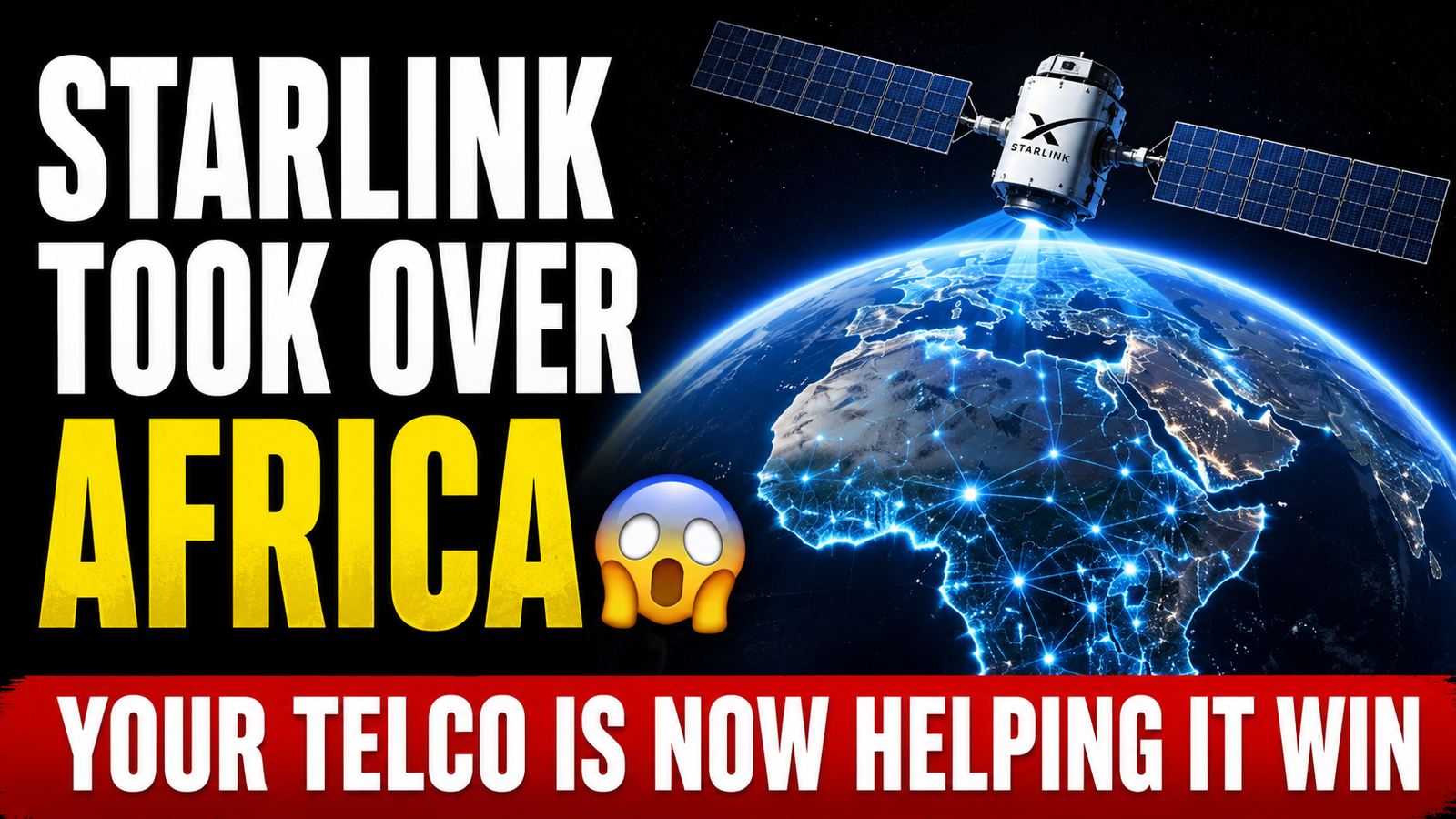
This is a full video that talks about this article
The satellite internet war in Africa is over. Starlink won and then turned its former enemies into partners.
What comes next is more important. Africa is on the verge of the most significant expansion of internet access in its history. The question is not whether Africans will get connected. The question is whether Africa will own a meaningful share of the digital economy that connectivity creates.
That answer depends on the policy decisions, the business strategies, and the informed public conversations that happen right now.
Stay informed. Follow Overite for weekly breakdowns of the African tech stories that matter.