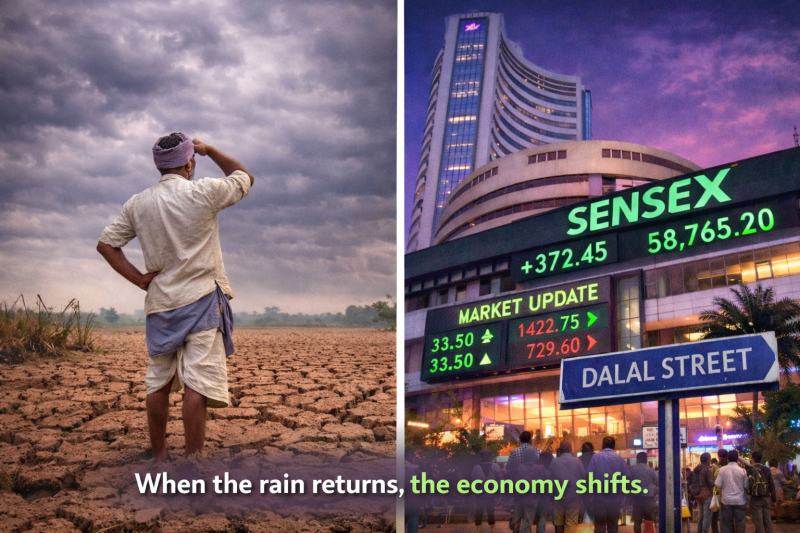
When it comes to predicting market movements,investors often look at economic indicators,policy changes and global trends. But in countries like India,one powerful and often underestimated factor plays a huge role: the monsoon.
At first glance,it may seem simple. If rainfall is good,the economy benefits.if it’s weak, markets react negatively.
But the reality is far more nuanced — and far more interesting.
What Is the “Long Period Average (LPA)”?
Every year, the monsoon forecast is summarized into a single number called the Long Period Average (LPA).This is essentially the average rainfall calculated over a long historical period, used as a benchmark to classify the upcoming monsoon as:
•Above normal
•Normal
•Below normal
For example, forecasts suggesting rainfall at around 92% of LPA indicate a below-normal monsoon,which can raise concerns about agriculture and economic growth.
But here’s the catch: this single number doesn’t tell the whole story
Why Markets React Instantly to Monsoon Forecasts
Each year, when the India Meteorological Department announces its forecast,the stock market reacts almost immediately.
Sectors that are highly sensitive to rural demand — such as:
•Fertilizer companies
•Agrochemical firms
•Tractor manufacturers
often see sharp price movements within minutes of the announcement.
The Economic Times
Why? Because the monsoon directly affects:
•Crop production
•Rural income
•Consumer spending
And in an economy where agriculture supports a large portion of the population, this ripple effect is massive.
Beyond LPA: The Real Drivers of Market Impact
While LPA gives a headline figure, investors who rely only on it risk missing the bigger picture. Several deeper factors influence how the monsoon actually affects the economy and markets:
1. Timing of Rainfall
It’s not just how much rain falls it’s when it falls.
Delayed rains can disrupt sowing, while early withdrawal can hurt harvesting.
2. Distribution Across Regions
Even if total rainfall looks “normal,” uneven distribution can damage crops in key agricultural zones.
3. Climate Patterns (El Niño & Others)
Phenomena like El Niño can weaken rainfall, impacting yields and pushing food prices higher.
4. Economic Linkages
•A weak monsoon can lead to:
•Lower rural demand
•Higher inflation
Slower GDP growth
In short, the relationship between rainfall and markets is multi-layered — not linear.
Why a Single Forecast Moves Markets Months Ahead
Interestingly,monsoon forecasts are announced in April,while the season typically begins in June.Yet markets react instantly.
This reflects a concept known as forward-looking pricing where stock prices adjust based on expected future conditions rather than current reality.
In other words,markets don’t wait for the rain. They trade on the expectation of it.
The Bigger Lesson for Investors
The key takeaway is simple: don’t oversimplify complex indicators.
The monsoon is one of the most important non-policy drivers of economic activity, but reducing it to a single number like LPA can be misleading.
Smart investors look beyond headlines and consider:
•Rainfall timing and spread
•Climate signals
•Sector-specific exposure
•Broader macroeconomic conditions
Final Thoughts
The intersection of weather and finance may seem unusual,but it highlights how deeply interconnected our world is.
A shift in rainfall patterns can move billions in market value not because of the rain itself, but because of what it represents: food security, rural prosperity, inflation, and growth.







Gift 1 month ago
This is nice But try and share this to all your followers and friends on social media so you can get more views and impressions thank you